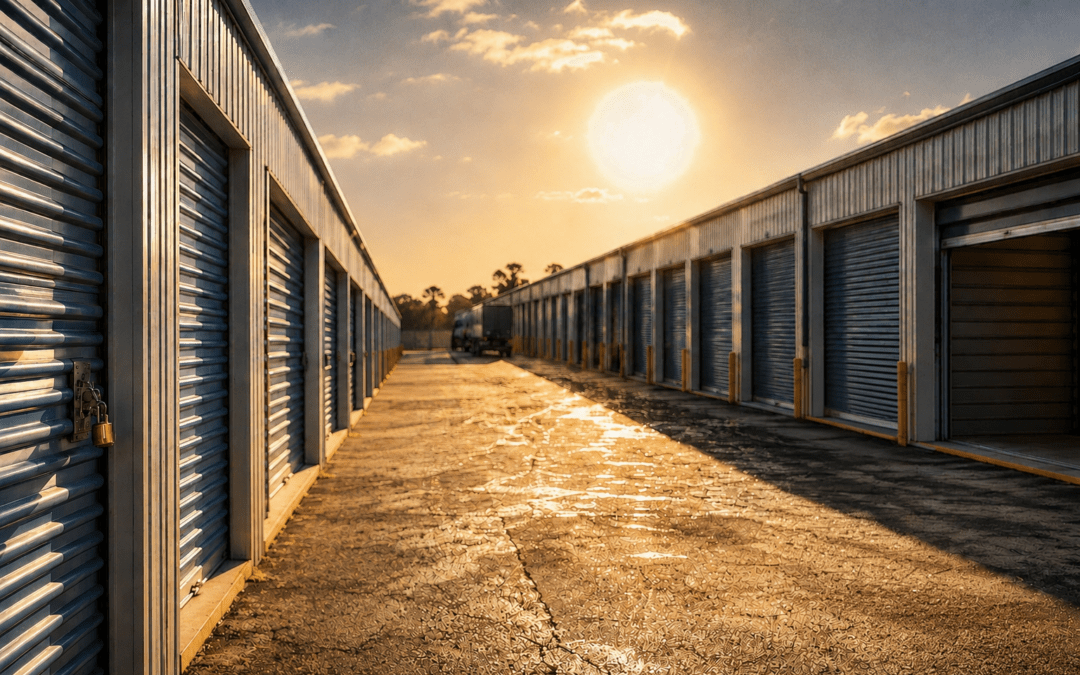
As the saying goes, you can’t judge a book by its cover. Turns out you can’t judge a self-storage facility by its looks either. It can be clean, well lit, nearly full, and still draw hard questions during self-storage insurance underwriting.
Commercial property catastrophe risk comes down to two things: the hazard on the map and how well the building is likely to hold up against it. Your clients can’t change their property’s location. The map is the map. What they can change is the building’s defenses. A well-maintained roof, cleared brush, and working drains all add up to a stronger property story, one that can help offset a hazard no one can move.
Below are the four major catastrophe exposures underwriters assess on self-storage accounts (flood, wind and hail, wildfire, and earthquake), along with the property details that can work in your client’s favor on each one.
Flood: The Zone is Only the Starting Point
FEMA defines a Special Flood Hazard Area as land that would be flooded by an event with a 1% chance of occurring in any given year. Facilities inside these zones get attention. So do facilities just outside them with poor site drainage.
Red flags underwriters tend to notice:
- Ground-level units with no elevation data on file
- Paved lots that pond or slope water toward the buildings
- Blocked or undersized storm drains
- Prior water losses, even small ones
Much of this can be fixable, and adding in an elevation certificate also gives the underwriter something concrete.
Wind and Hail: Roofs and Roll-Up Doors Carry the Load
Self-storage buildings have large expanses of roofing and a lot of doors. In hail country and along the coast, that combination gets noticed. Underwriters want the roof’s age, material, attachment method, and date of last replacement or inspection. An older roof in a hail-prone region, with nothing in writing about its condition, is a common reason a submission slows down.
Then there are the doors. The Insurance Institute for Business & Home Safety (IBHS) has made overhead roll-up doors one focus of its commercial wind research. In one full-scale IBHS test, a building built to stronger standards had minimal damage, while a conventional one suffered a chain of failures ending in total loss. Wind-rated doors belong in the submission. Photos help.
Wildfire: What Surrounds the Building
Dry brush along the fence line, wood mulch against a wall, tree limbs hanging over a roof, an unmanaged lot next door. Underwriters look closely at what sits near the buildings. Federal wildfire mitigation guidance supports managing vegetation in zones around a structure, and the first five feet should be kept noncombustible with gravel, rock, or pavers. That guidance was written mostly for homes, but the principle applies here, too. A written maintenance schedule shows the work will continue.
Earthquake: Not Only a West Coast Question
The 2023 USGS National Seismic Hazard Model found that nearly 75% of the U.S. could experience damaging earthquake events, with higher potential along the central and northeastern Atlantic corridor. Building age and structural design carry a lot of the weight. Older masonry and multi-story facilities without documented retrofit work are worth raising with the business owner early.
Checklist: What to Gather When Red Flags Start to Stack
A well-documented facility in a flood zone can still find a home. The real trouble starts when exposures pile up, like a hail-exposed facility with an aging roof and two prior storm claims.
Stacked concerns can affect eligibility, pricing, deductibles, capacity, and policy terms. How much depends on the account. This is where an owner’s catastrophe risk management work pays off, as long as someone documents it. Before the submission goes out, gather:
- Flood zone designation and, if available, an elevation certificate
- Roof age, type, and date of last replacement or inspection
- Door wind ratings and any storm-related upgrades
- Recent photos of site drainage and the ground around each building
- Loss history, with notes on repairs after each claim
- Records of vegetation management, seismic retrofits, or emergency planning
Why Self-Storage Risk Management Calls for a Specialist
MiniCo has built specialized insurance programs for the self-storage industry since 1974. For agents placing commercial self-storage insurance, MiniCo’s program teams can help frame a higher-hazard account around the self-storage risk management work the owner has already done.
FAQs
What catastrophe risks affect self-storage insurance underwriting?
Flood, wind and hail, wildfire, and earthquake, each weighed against the facility’s physical condition.
How do flood zones affect commercial self-storage insurance?
A location in a Special Flood Hazard Area usually brings closer review and may affect deductibles or terms.
How can self-storage facilities reduce wildfire risk?
Clear combustible vegetation near the buildings, keep the ground immediately around them noncombustible, and document upkeep.
What do underwriters look for in wind and hail exposed commercial properties?
Roof age and condition often come first. For self-storage, roll-up door ratings matter too.
How does earthquake risk affect commercial property insurance?
USGS hazard maps are used in the risk models behind insurance rate structures, so seismic exposure can shape terms well outside the West.
Call on MiniCo for Specialized Expertise
Whether you’re placing commercial self-storage insurance or coverage for self-storage facility owners and operators, bring catastrophe-exposed accounts to MiniCo early. Our underwriters can help you spot what needs support before the submission goes out. Contact us today.